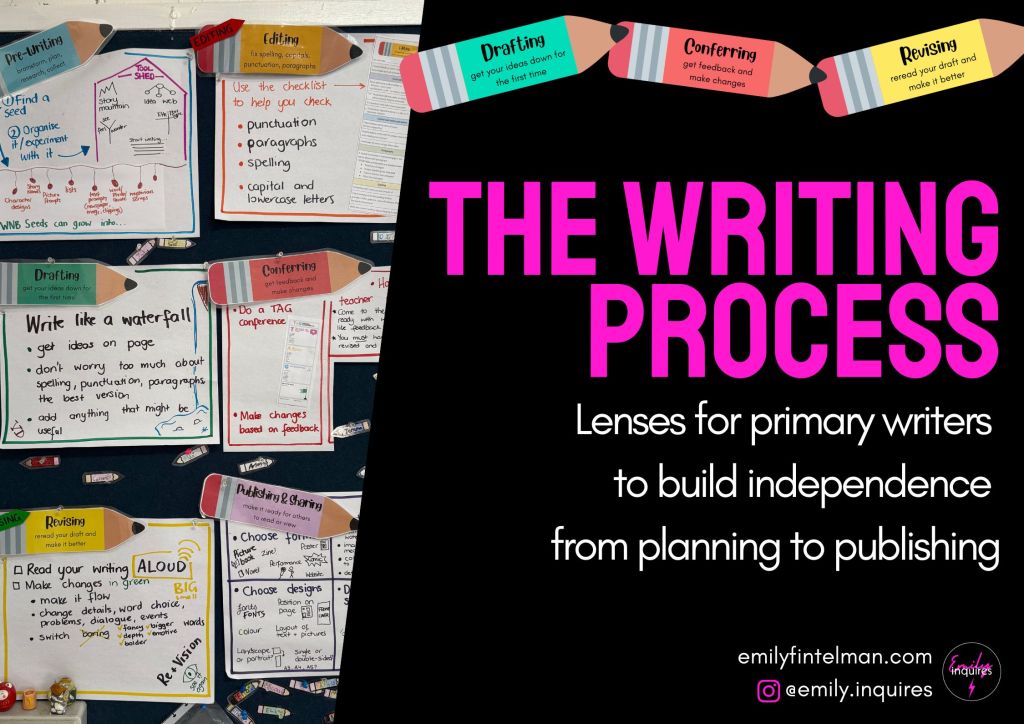
It’s not really THE writing process. It’s A writing process. And it’s not necessarily a linear process. It’s a collection of lenses for improving writing from different perspectives.
Pick up any book on teaching writing and it’ll deliver you a different version of The writing process. That’s ok. I don’t think there are two authors in the world who would agree that every step is the same, has the same name, or even has a name.
But for the purposes of SEO, let’s call it The Writing Process today.
What is the writing process and why teach it?
The Writing Process refers to the different phases a writer can move through to created a finished piece of writing.
I have experimented with many different versions of “the” writing process for years (and I’ll keep doing so), but generally the process I use with students is one I think originally came from Donald Graves: plan, draft, revise, edit, publish. I also add confer (an important puzzle piece in the making of a class writing community).

The process I use when teaching writing is this:
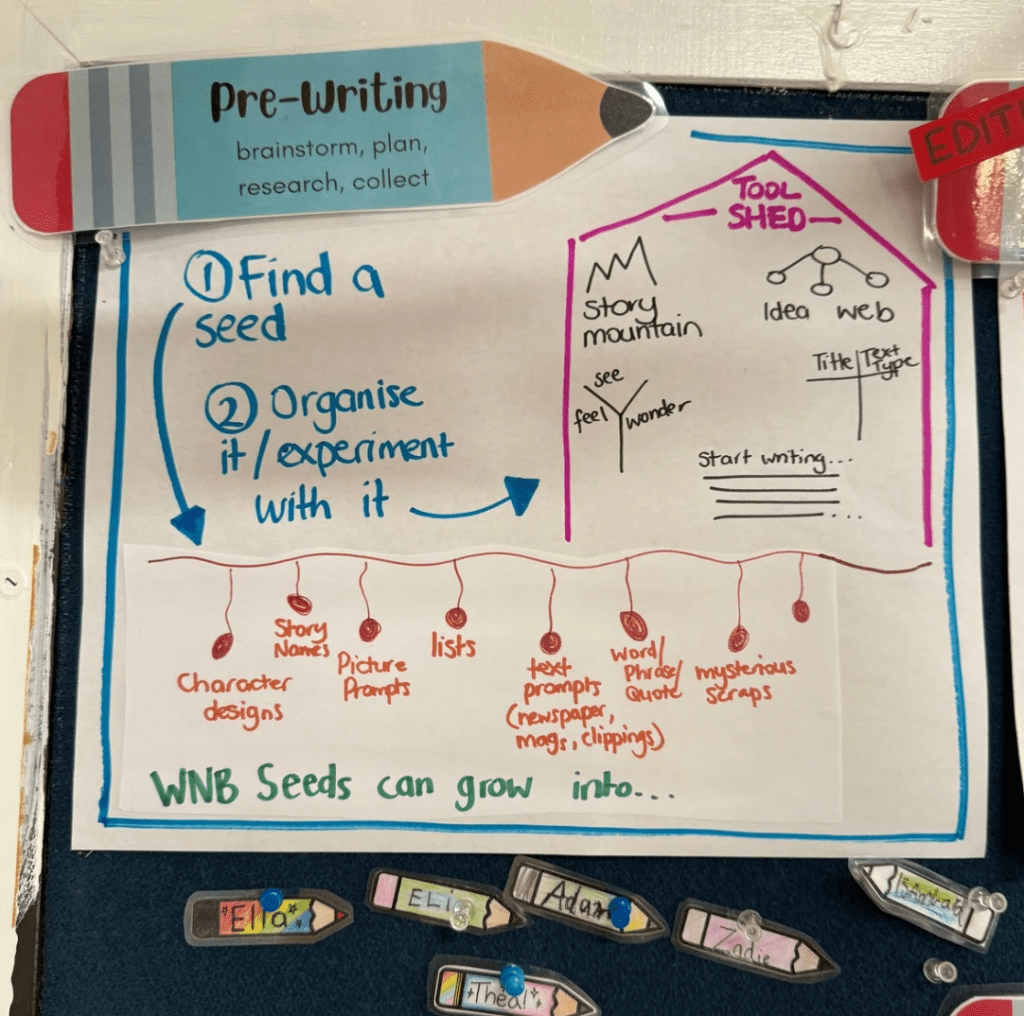
- Plan: collect ideas, play with them, organise them
- Draft: get something on the page
- Revise: make it sound and feel great
- Edit: make it correct. Work on punctuation, spelling, paragraphing
- Confer: get the feedback of other writers and use it
- Publish: make it ready for others to view
Lenses for writing
It can be powerful to help students understand that there are different phases to writing, and that they can use these to work on their writing in different ways.
I think of it like putting on different shades of sunnies that alter the colours we see: each phase of the writing process helps us concentrate on a different way of seeing our writing. It makes the huge and often overwhelming task of writing much more focused and manageable.
If we’re revising, we want it to sound better and get our message across.
If we’re editing, we want it to be universally read-able.
If we’re conferring, we want to hear what others think to help us make our writing better.
How to introduce the phases of the writing process
I introduce each phase gradually through the year, bringing them in as needed. We develop the language, tools and our own story around each phase through discussion, creativity and trial and error. I strongly believe that this has to be a discussion developed together, not a set of laminated charts to memorise and adhere to (see Emily’s class circa 2012). I find that in upper primary there are already many existing understandings about writing processes and that we can easily co-create a shared understanding, with some teacher guidance, prompting and explanation.
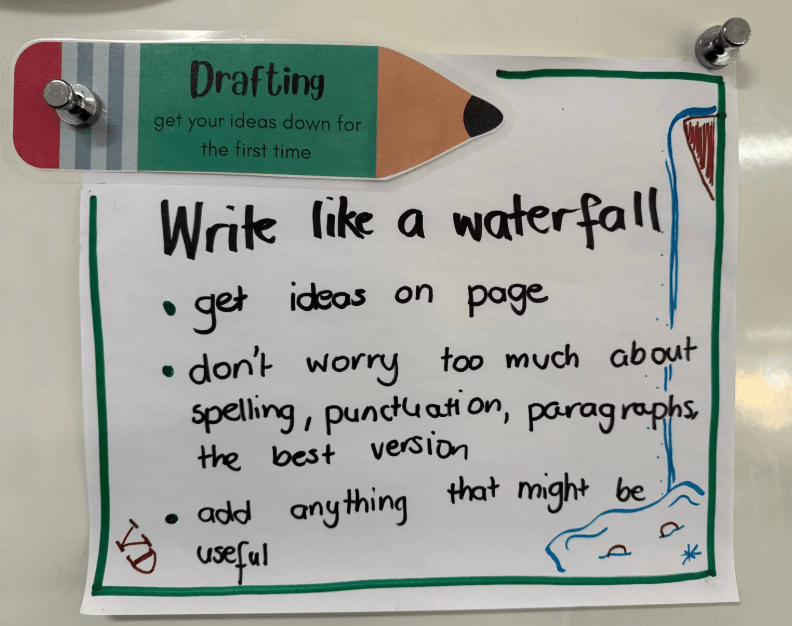
Drafting: Waterfall or vomit?
For example, when we discussed drafting, one student suggested a waterfall to represent ideas flowing while we draft. Many students resonated with this and joyfully built on the metaphor. We agreed this is how we would describe drafting.
But, a small contingent of students rejected the waterfall, remembering a visiting author call it a ‘vomit draft’, where all your ideas just spew onto the page, and it probably won’t be pretty at this point. They wanted this shown on the anchor chart. A spirited discussion led us to using ‘brown, fancy, not gross, letters’ to write the initials for vomit draft so that the die-hard vomit analogy fans felt represented. Please don’t just write ‘vomit draft’ on your chart. I explain this to illustrate how we co-construct our definitions together, based on the needs and experiences of the group.
I introduce a phase just in time, when we need it for whatever we are working on. This means students get to practice straight away. It also means it’s not perfect the first time around. Over the year, we return to our understandings and refine them.
Integrating the Writing Process: Hot Tips
Here are some ways I integrate the process into the work we’re already doing:
⚡️Model working in a phase of the process when I write pieces in front of students. I use the shared language we’ve built to thinkaloud about my writing choices. E.g. “Today I’m going to revise my poem. I’m not editing yet, so I’m not looking for spelling errors. Since I’m revising, I’ll be looking for ways to make it sound even better. Maybe I’ll improve some words or take some bits out”.
⚡️Check in with the writing process when we set off to write. My current class use our little pencils to keep track of where we’re at. Myself and children track where we are at with writing pieces and students are expected to be able to prove their work in each phase.
⚡️I share examples of authors talking about their process. For example Lili Wilkinson on receiving feedback, Graeme Base on how to find ideas or Kate DiCamillo’s first five drafts and revisions of Because of Winn Dixie.
⚡️We learn and use specific strategies for different phases. For me, this is where the writing traits come in, and we get specific about what kinds of moves we can do as writers in each phase. Some examples below.
| What writing process phase are we in? | What are some writing strategies might we learn, use or revise? |
| Planning | ✏️Draw a picture to show your story idea ✏️Use graphic organisers to sort ideas ✏️Look for ideas in your writers notebook ✏️Get every idea down, and circle your favourites |
| Drafting | ✏️Write your worst version ✏️Use your planning to guide you ✏️Let your ideas flow |
| Revising | ✏️Listen for repeated words, and use synonyms to swap them ✏️Add Tier 2 or 3 words ✏️Add a literary device (e.g. personification, simile, alliteration) ✏️Kill your darlings |
| Editing | ✏️Read aloud for missing full stops ✏️Check names for capital letters |
| Conferring | ✏️Do a TAG conference with a peer to get feedback ✏️Use the author’s chair to ask the class for feedback |
| Publishing and Sharing | ✏️Make a front cover that gives a sneak peek (without giving too much away!) ✏️Pick a font that enhances the message ✏️Choose: print, type or perform? |
Note: This is an extremely non-exhaustive list. Learning and practising specific writing strategies like these is the bulk of my teaching of writing throughout a year. As we learn and apply them, we discuss which writing process phase they belong in. When students know how and when to use a strategy, they are empowered to employ the strategies independently when working on other pieces of writing, no matter the audience, topic or genre.
Freebie: Writing Process pencils
Grab the writing pencils I use to kick off conversations about each step of the writing process.
 Mrs Fintelman Teaches